projects / a project
demo · 2026
nomatch
One question: why didn't this document show up in my search? Runs entirely in the browser, on turbopuffer's own tokenizer compiled to WebAssembly.
Overview
Paste some text, type a search, and see which documents come back under two tokenizer configurations at once. For the ones that did not come back, nomatch names the stage of the analysis pipeline that dropped them, and the single option that brings them back.
It runs on alyze, the tokenization library
turbopuffer runs in production behind their word_v4 tokenizer,
compiled to WebAssembly and hosted in a Web Worker. No server, no account, no network call to
anyone's product. Nothing you paste leaves the tab.
There is no turbopuffer account behind this and it is not affiliated with them. The analysis
engine is the real alyze, MIT licensed, compiled from commit 1de437c. The BM25 ranking is
mine, written for this project. It follows the documented meaning of k1, b and k3, but it
is not their code and it is not a reference for how their production ranking behaves.
I built it to understand how a search engine decides what comes back, at the level where I could rebuild the deciding part myself. Shipping a Next app is not the test. The retrieval layer underneath it is.
The problem it solves
A search engine does not store your text. It cuts the text into pieces called tokens and stores the pieces. When you search, it cuts your search the same way and compares piece to piece. A match happens only when two tokens are exactly equal.
Stored document: O café da manhã estava ótimo. Your search: cafe.
With ascii_folding off, which is the default, the document holds café, the search becomes
cafe, and nothing comes back. The document is there. The word is there.
Today you find that out by paying for an account, uploading your data, searching, finding nothing, and then guessing which of five options was the culprit, one at a time.
In English this almost never happens, because English has no accents. It shows up the moment you index Portuguese, French, German or Spanish. That is why I built it, and it is why the default corpus is in Portuguese.
The stage ladder
alyze returns the final result of the analysis, not the steps it took. To find which step killed a match, nomatch runs the analyzer several times with the options turning on in cascade, then diffs the outputs.
S0  tokenize only            case_sensitive: true
S1  + lowercase              case_sensitive: false
S2  + remove stopwords       remove_stopwords: true
S3  + stemming               stemming: true
S4  + ascii folding          ascii_folding: true
Stemming and stopword removal only appear from S1 on, because both require
case_sensitive: false.
For one search word against one document word, the ladder tracks two indices: the first stage where both sides are alive and textually equal, and the first stage where the document word goes from alive to dropped. The first is structurally always before the second, because a dropped token can never equal anything. That gives three verdicts, and no fourth:
- converged at some stage, so the match needs that stage's option on
- disappeared at some stage, so that stage dropped it, and for a stopword the interface names the word
- never, meaning different words, not a configuration problem
max_token_length sits outside the ladder. It is checked in bytes and reported on its own,
because a document can simultaneously have no word anywhere near the search and, separately, a
search term too long to ever become a token.
What it proves
The ladder is the product. The rest exists to make it possible, and each piece has a specific failure it is there to prevent:
- The recommendation names the narrowest option that works, not the stage the cascade lands
on. The cascade is cumulative, so it can only report which prefix of the pipeline makes two
words equal. With
language: portuguesethe Snowball stemmer strips the final vowel from bothcafeandcafé, so the cascade converges at stemming, one stage before folding. The ladder was telling the truth and giving bad advice: stemming collapses whole families of words across a corpus,ascii_foldingonly touches accents. It now asks the analyzer which single options actually close the gap, and prefers the narrowest. - A document removed by exact phrase gets its own answer, decided outside the ladder. A document can hold every word of the query and still be absent, because phrase order removed it. The ladder cannot see that, and left alone it reports five stages of match on a document listed as missing. Only the matcher holds both results on the same tokens, so it flags the case rather than letting the ladder guess.
- A query that analyzes down to zero tokens is caught before any of this runs. Searching
dawithremove_stopwordson andlanguage: portugueseis not "no documents matched", it is nothing to compare against anything, and it says so by name. - Ranking never reaches the analyzer. Measured in the browser by counting
postMessage: a search over the example corpus costs five calls, one for the query and one per document. Movingk1,bork3afterwards costs zero, and the order still changes on screen. - Positions keep their holes. Every word spends a position even when a filter throws it away, which is what keeps phrase distance correct. The token view renders the gaps instead of hiding them, and phrase matching compares position deltas rather than array indices, so a stopword dropped identically from both sides does not break a phrase but a real word sitting between the terms does.
A finding I left alone
Searching manha against a document holding manhã, in Portuguese, is classified never.
The stemmer strips the final vowel from manha but leaves manhã untouched, because the accent
means it no longer matches the same suffix rule. ascii_folding runs after stemming, so by the
time manhã folds to manha, the query has already been stemmed down to manh. They never
converge.
Two forms of what a person would call the same word, ending up unreachable because of pipeline
order rather than because anything is wrong. The ladder is reporting the pipeline honestly, so
it stays. The stemming test case uses correr and correu instead of an accented pair,
specifically to keep that test from tripping over this.
Reproducing the miss
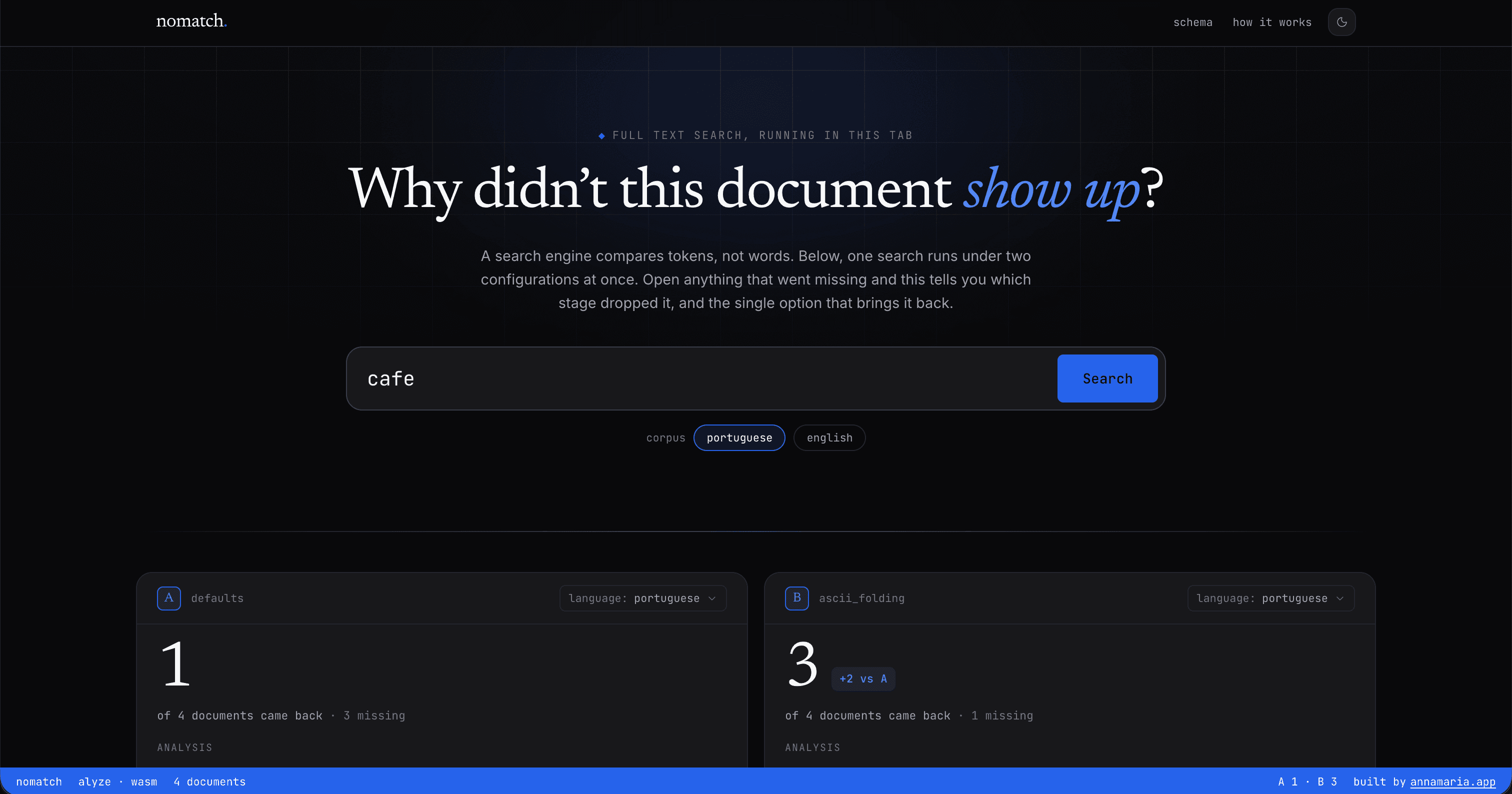
The page opens with a corpus loaded and a search already run, so the contrast is on screen
before you touch anything. Column A is the real defaults and finds one document. Column B has
ascii_folding on and finds three. The two extra ones spell café with the accent.
Click any document under missing to open the ladder for it, and the button at the bottom of
the panel applies the fix to the other column and closes the drawer. This is a comparison
tool, so the button's job is to build the comparison that proves the fix, not to mutate the
thing you were reading. The 0 that showed the problem stays on screen next to the count that
proves the fix.
Switch the corpus to English and the same failure is close to invisible, which is the point of
having it. What breaks there is a plural: cafes does not find cafe until stemming is on. So
each corpus carries its own search and its own fix, and both open on the same contrast for
different reasons.
On the ranking
BM25 decides the order of the documents that already matched, and never decides whether a
document comes back. k1 defaults to 1.2, b to 0.75, k3 to 8.0, matching turbopuffer's
documented defaults, and all three are adjustable per column.
Two calls worth naming:
- The IDF is the smoothed form,
ln(1 + (N - n + 0.5) / (n + 0.5)). The textbook form puts the 1 outside the log and goes negative as soon as a term appears in more than half the documents. On corpora of five pasted sentences that is not an edge case, it is Tuesday, and a negative score on screen costs more trust than the precision buys. - Document length is the tokens that survived analysis, not the positions spent. A document is not longer, in any sense ranking cares about, because it happened to contain stopwords that were removed before indexing. The holes still matter and still exist, they just do not feed the average.
Stack
- Next.js and TypeScript, Tailwind v4, entrepta on the
boscotheme - alyze compiled to WASM with
wasm-pack --target web, committed underpublic/wasm/and served by URL rather than through the bundler - An ES module Web Worker hosting the module, because running the ladder over a corpus on the main thread blocks it
- BM25 in TypeScript, over the tokens the analyzer returns
The full build ships all 18 stemming languages at 392 KB uncompressed, so there was nothing to trade off by cutting any. The language picker offers Portuguese and English, and that is a restriction in the interface, not in what got compiled.
Running locally
There's a live demo at the link above. To run it locally instead:
npm install
npm run dev
Opens at localhost:3000. The compiled WASM artifact is committed, so you do not need Rust to
run the app. Building it from source is a separate job, documented in CLAUDE.md.
Tests
Vitest covers what breaks quietly: the ladder against known cases (an accent, a Portuguese stopword, a stemming root, a token over the byte limit), byte count against character count in accented text, BM25 against numbers worked out by hand before the code existed, and invalid option combinations blocked before they reach the analyzer.
The end-to-end path, WASM to worker to match, is covered by a Playwright smoke test against the running app rather than by the unit suite. Vitest tests the logic; the smoke test proves the pipeline is actually wired together, in dev and in a real production build. The build is half the test, because the worker and the WASM module break exactly on the crossing between the two.
Every claim the interface makes has a test behind it, and the tests fail when the claim stops being true.
License
MIT. alyze is MIT too, and its copyright stays with turbopuffer.