projects / a project
demo · 2026
capacity
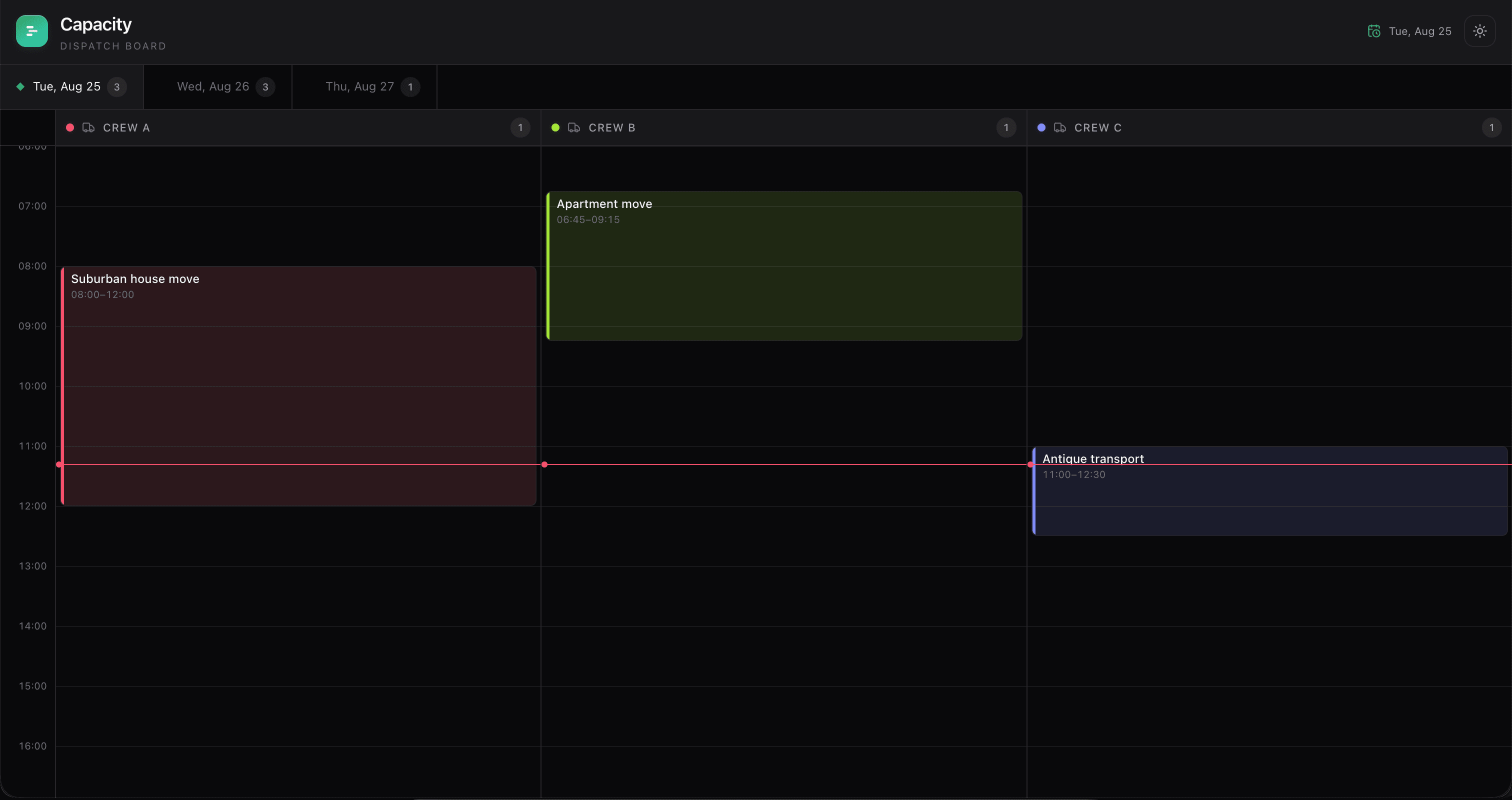
A small dispatch board: crews and trucks as columns, jobs scheduled inside time windows, draggable between crews and between days.
Overview
A small dispatch board: crews and trucks as columns, jobs scheduled inside time windows,
draggable between crews and between days, by mouse, touch, or keyboard. Arrow keys move a
picked-up job, Tab/Shift+Tab switches days mid-drag, and neither one is an afterthought
bolted on after the mouse path was done.
It's a personal project, not a product. I built it to practice GraphQL, Apollo Client, and drag-and-drop across groups that aren't all on screen at once, in one real flow instead of three separate tutorials. The domain is moving-company dispatch, picked because it comes with real constraints (finite crews, finite trucks, time windows that collide), so the interesting problems show up on their own instead of getting forced onto a generic to-do list.
What it proves
dnd-kit handles the drag mechanics. The part that actually matters starts at the drop:
- An optimistic mutation with a real, visible response to rejection. The block snaps back to where it was and a toast says why. A mutation that only handles the accept case is the happy-path demo this project exists to not be.
- Cross-day drag through tab auto-switch on hover, and the keyboard equivalent, not a fallback for it.
- Every list resolver batches through a DataLoader, with a query-count test that fails on purpose if one gets removed.
- Concurrency with no WebSocket, subscription, or polling. Two people editing the same board resolve on "the server decides, the client undoes."
Reproducing the conflict
Open two tabs on the same board. Drag a job into an empty slot in the first tab and confirm
the move. Without reloading the second tab, drag a different job into that exact slot. Its
local collision preview shows nothing wrong, because it has no way to know the first tab
already took it. On drop, the server rejects the move: the block snaps back and a toast names
what's already there. apps/web/e2e/concurrency-conflict.spec.ts runs the same scenario with
two Playwright browser contexts.
Stack
- Next.js, Apollo Client, dnd-kit on the frontend
- Flask, Graphene, and SQLAlchemy on Postgres for the API
- Turborepo and npm workspaces tying the two together
Running locally
There's a live demo at the link above. To run it locally instead:
docker compose up -d postgres
npm install
cd apps/api && uv run python seed.py && cd ../..
npm run dev
Opens at localhost:3000. No .env file needed for the default setup: Postgres is mapped to
localhost:5434, and both apps already fall back to that.
Tests
The full pyramid: Vitest for the pure logic (geometry, snapping, local collision, the
auto-switch threshold, none of it needs a DOM), Testing Library for focus and ARIA, Apollo's
MockedProvider for loading, error, and rollback, Playwright for the real drag and the
two-context conflict, and pytest on the API for resolvers and query counting.